For many small to medium businesses in New Zealand, IT support only becomes a priority when something stops working. A server goes down, email becomes inaccessible, or staff are unable to log in to critical systems. At that point, IT turns from a background function into an urgent problem that needs fixing immediately.
For years, break-fix IT support has been the default option for many businesses. You call an IT provider when something breaks, pay for the fix, and move on. While this approach can work in very small environments, it often starts to fall apart as businesses grow and become more reliant on technology.
Today, more business owners are comparing break fix vs managed IT support to understand which model truly delivers better value. The difference is not just about cost. It is about risk, downtime, productivity, and long-term return on investment.
This article explores the real differences between break-fix and managed IT support, helping small businesses make informed decisions about their IT support services.
What is Break-Fix IT Support?
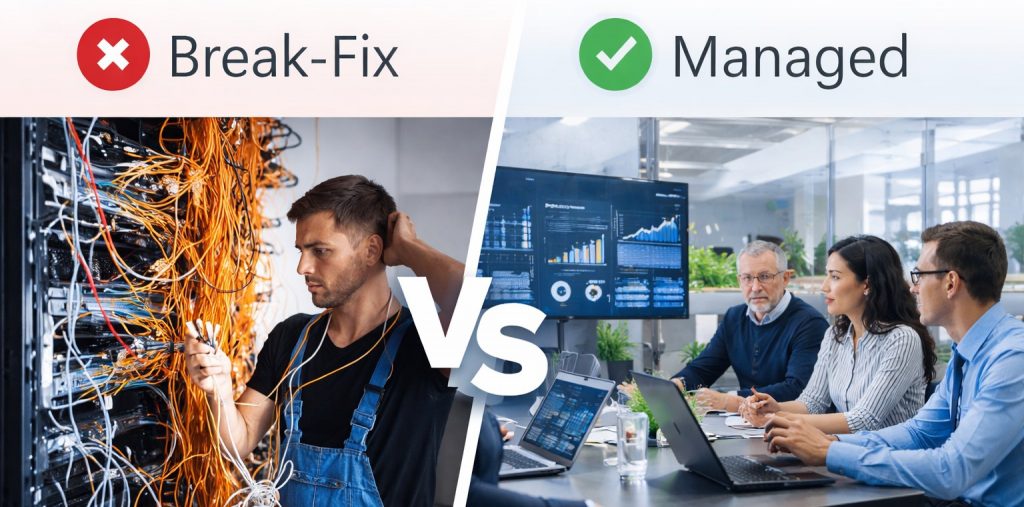
Break-fix IT support is a reactive service model. When something breaks, you contact an IT provider who fixes the issue and charges for their time, parts, and any additional work required. There is no ongoing relationship or responsibility for system health beyond the immediate repair.
For very small businesses with minimal IT requirements, break-fix can feel simple and flexible. There are no monthly fees and no long-term commitments. However, this model places most of the responsibility and risk on the business itself.
Because there is no proactive maintenance, problems often develop unnoticed. Security updates may be missed, backups may fail without warning, and ageing hardware can remain in use long past its safe lifespan. Issues are only addressed once they disrupt operations.
What Is Managed IT Support?
Managed IT Support is a proactive model where an IT provider takes ongoing responsibility for maintaining, monitoring, and supporting your technology environment. Instead of paying per incident, businesses pay a fixed monthly fee that covers most day-to-day IT support services.
This model is particularly well suited to managed IT support for small businesses that rely on email, cloud platforms, and secure access to data. Rather than reacting to failures, managed IT support focuses on prevention, performance, and long-term stability.
Systems are monitored continuously, updates are applied regularly, and potential issues are addressed before they become serious problems. The result is a more reliable IT environment and fewer unexpected disruptions.
Comparing Costs: Visible and Hidden
At first glance, break-fix IT often appears cheaper. You only pay when something goes wrong, and invoices are tied directly to work performed. For businesses that experience infrequent IT issues, this can seem cost effective.
However, this approach rarely accounts for hidden costs. Downtime can be expensive, even if it is not immediately obvious. When staff cannot work, productivity drops. Deadlines are missed, customers become frustrated, and revenue can be affected.
Emergency call-outs also tend to cost more than planned work. Issues that could have been prevented with regular maintenance often require urgent fixes that are more expensive and disruptive.
Managed IT support offers predictable monthly costs. While there is an ongoing fee, it typically covers monitoring, maintenance, security, and support. Over time, many businesses find this model reduces unexpected expenses and makes budgeting far more accurate.
Risk Management and Business Continuity
Risk is one of the biggest differences when comparing break fix vs managed IT support. With break-fix, businesses carry most of the risk themselves. If backups fail, security patches are missed, or hardware degrades, problems may go unnoticed until something breaks.
Managed IT support reduces this risk through proactive IT support services. Systems are monitored around the clock, backups are checked regularly, and potential failures are identified early. This significantly reduces the likelihood of major outages.
For businesses that depend on continuous access to systems and data, this proactive approach can be critical to maintaining operations and customer trust.
Cybersecurity Considerations
Cybersecurity has become a major concern for small businesses across New Zealand. Cybercriminals increasingly target smaller organisations, knowing they often lack strong defences.
Break-fix IT support typically addresses security reactively. If a breach occurs, the focus is on cleaning up the damage rather than preventing the incident in the first place. This approach leaves businesses vulnerable.
Managed IT support usually includes cybersecurity as a standard part of the service. This is especially important for organisations relying on small business IT support NZ wide. Regular updates, endpoint protection, email security, and network monitoring all help reduce exposure to threats.
By maintaining security controls consistently, managed IT support significantly lowers the risk of costly cyber incidents.
Impact on Productivity and Staff Experience
IT issues do more than disrupt systems. They interrupt workflows and frustrate staff. When technology is unreliable, employees spend time troubleshooting problems instead of focusing on their roles.
With break-fix IT, these interruptions can be frequent and unpredictable. Staff may wait hours or days for issues to be resolved, particularly if support is not readily available.
Managed IT support improves the staff experience by providing consistent access to help and reducing the number of problems that occur in the first place. Over time, this leads to better productivity and less frustration across the organisation.
Scalability as Your Business Grows
As businesses grow, their IT needs become more complex. New staff require devices and access, data volumes increase, and security requirements become more demanding.
Break-fix IT struggles to scale because it is reactive by nature. Managed IT support is designed to grow alongside the business. This includes planning upgrades, managing cloud services, and ensuring systems remain reliable as demands increase.
Many organisations looking for IT support services Auckland businesses trust choose managed support because it provides structure and long-term planning rather than short-term fixes.
Evaluating Return on Investment
When evaluating ROI, it is important to consider more than just IT invoices. Reduced downtime, improved productivity, stronger security, and better planning all contribute to long-term value.
Managed IT support often delivers a stronger return on investment by turning IT into a predictable, reliable service rather than a constant source of disruption. For many businesses, this shift allows technology to support growth rather than hinder it.
Which IT Support Model Is Right for You?
There is no universal answer. Very small businesses with minimal IT reliance may find break-fix acceptable in the short term. However, as soon as technology becomes critical to daily operations, managed IT support usually provides better protection and value.
Understanding the differences between break-fix and managed IT support allows business owners to make informed decisions about their IT support services.
Next Steps
If you are deciding between break-fix and managed IT support, the best place to start is understanding your current environment. Book a 15-minute IT Strategy Call to discuss whether managed IT support for small businesses is right for you and learn more about our IT support services Auckland organisations rely on and how we help New Zealand businesses reduce risk and improve performance.