BlueCloud

What Is Cloud Telephony (Cloud PBX) and How Does It Work?

Business phone systems have changed dramatically over the past decade. Traditional on-site PBX hardware is no longer the only option for managing calls, extensions, voicemail, and call routing. Increasingly, New Zealand businesses are moving to cloud-based systems that are more flexible, scalable, and easier to manage.

At the centre of this shift is the Cloud PBX. For many small and medium businesses, especially those in Auckland and across New Zealand, understanding how a Cloud PBX works is the first step towards modernising communications without the cost and complexity of legacy systems.

In this article, we explain what a Cloud PBX is, how it works, how it differs from traditional phone systems, and why it is becoming the preferred choice for growing organisations.

What is a Cloud PBX?

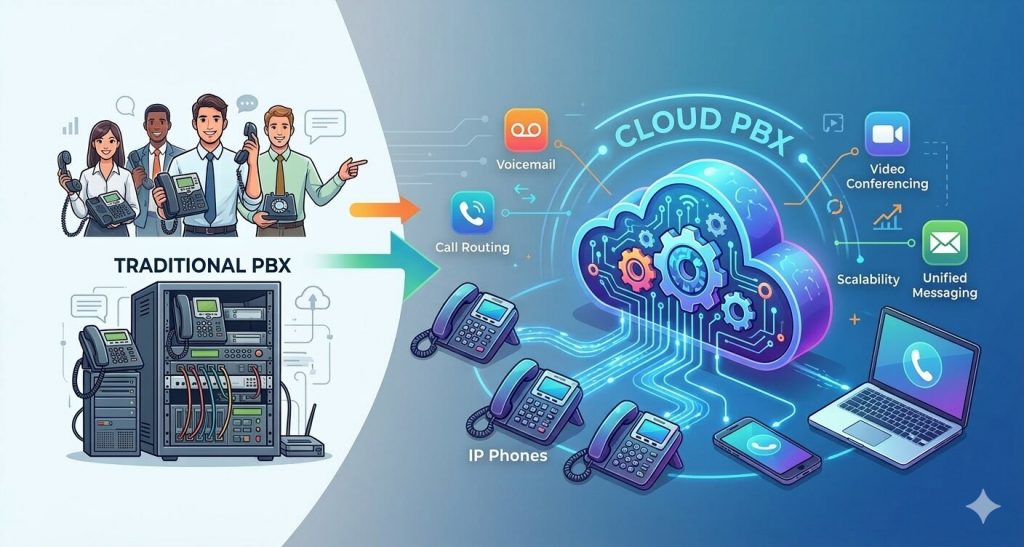
A Cloud PBX is a private branch exchange that is hosted in the cloud rather than on physical hardware in your office. Traditionally, a PBX system required on-site equipment to connect internal extensions and route external calls through telephone lines.

With a Cloud PBX phone system, that infrastructure is hosted securely in a data centre. Your handsets, softphones, or mobile apps connect to the system over the internet. The intelligence that manages call routing, voicemail, auto attendants, and extensions sits in the cloud instead of in a cabinet in your comms room.

This removes the need for expensive on-site hardware and ongoing maintenance of legacy systems.

How does a Cloud PBX actually work?

A Cloud PBX works using Voice over IP, often referred to as VoIP. Instead of transmitting voice calls through traditional copper lines, your voice is converted into digital data and sent over your internet connection.

what is cloud pbx

When someone dials your business number, the call is routed through your Cloud PBX provider’s platform. The system then applies your configured rules. It might send the call to an auto attendant, ring a hunt group, forward to a mobile device, or direct the caller to voicemail.

Because the system is hosted in the cloud, changes can be made remotely. Adding a new extension, updating a greeting, or changing call routing does not require a technician to visit your office.

Core features of a Cloud PBX phone system

Most Cloud PBX phone system platforms include features that were once only available to larger enterprises. These commonly include:

  • Auto attendants and call menus
  • Call queues and hunt groups
  • Voicemail to email
  • Call recording
  • Mobile and desktop softphones
  • Call reporting and analytics
  • Integration with CRM systems


For many businesses, these features improve customer experience and internal efficiency without requiring complex infrastructure.

Why businesses are moving to cloud phone systems in NZ

The shift to a cloud phone system nz wide is driven by flexibility and cost predictability. Traditional PBX systems require upfront capital expenditure, ongoing maintenance, and physical capacity planning.
A Cloud PBX for small business typically operates on a monthly per-user model. This means costs scale with your team size. If you grow, you add licences. If you downsize, you reduce them.
For Auckland-based businesses with hybrid or remote staff, the flexibility of a cloud phone auckland deployment is especially valuable. Staff can take calls from anywhere using a laptop or mobile app while presenting the same business number to customers.

Cloud PBX vs traditional PBX: key differences

The most obvious difference is location. Traditional PBX systems sit in your office. A Cloud PBX is hosted externally in secure data centres.
Maintenance is another major difference. With a traditional system, upgrades and fixes often require on-site work. With a cloud system, updates are handled centrally by the provider.
Scalability is also dramatically improved. Adding new users to a traditional system may require hardware upgrades. In contrast, a Cloud PBX phone system can often add users within minutes.

Internet requirements and call quality

Because a Cloud PBX relies on internet connectivity, connection quality matters. Businesses need stable broadband with sufficient bandwidth to handle concurrent calls.
Modern fibre connections in Auckland and across New Zealand are typically more than capable of supporting VoIP traffic when configured correctly.
Quality of Service settings on your network can prioritise voice traffic, ensuring calls remain clear even during heavy internet usage.

Security considerations

Security is an important part of any cloud phone system nz deployment. Reputable Cloud PBX providers use encryption to protect voice traffic and secure data centres to host infrastructure.
Access controls, strong authentication, and proper network configuration further reduce risk.
When implemented correctly, a Cloud PBX can be as secure, if not more secure, than traditional phone systems.

Disaster recovery and business continuity

Agent on phone

One significant advantage of a Cloud PBX is resilience. If your office loses power or internet connectivity, calls can often be redirected to mobile devices or alternate locations.

Because the core infrastructure is not tied to your physical site, business continuity improves.
For small businesses, this resilience can be critical during unexpected disruptions.

Integration with other business systems

Modern Cloud PBX platforms can integrate with CRM systems, helpdesk tools, and collaboration platforms.
For example, incoming calls can trigger screen pop-ups showing customer details. Call recordings can be linked to support tickets. Analytics can reveal call volumes and peak times.
These integrations turn your phone system into part of a broader communications strategy rather than a standalone tool.


Is a Cloud PBX right for every business?

While a Cloud PBX for small business suits most modern organisations, there are considerations.
Reliable internet connectivity is essential. Businesses with highly specialised telephony requirements may need tailored solutions.
However, for the majority of SMBs in Auckland and across New Zealand, cloud telephony offers flexibility, lower upfront cost, and easier management compared to legacy systems.

Choosing the right Cloud PBX provider

Not all Cloud PBX providers are equal. When evaluating options, consider:

  • Local support availability
  • Network quality and uptime guarantee
  • Feature set and scalability
  • Integration capabilities
  • Transparent pricing


Working with a provider who understands the New Zealand market and can support a cloud phone auckland deployment ensures smoother implementation and ongoing support.

Implementation and migration

Migrating to a Cloud PBX phone system typically involves porting existing phone numbers, configuring users and call flows, and deploying handsets or softphones.
With proper planning, migration can occur with minimal disruption.
Testing before full cutover ensures call routing works as expected and staff are comfortable with new features.

The future of business telephony

The future of business telephony is increasingly shaped by cloud platforms, collaboration tools, and AI-driven innovation. Modern Cloud PBX systems are no longer just voice platforms; they form part of a broader digital workplace strategy that integrates voice, video, messaging, and CRM systems into a single communications ecosystem.
Advances in artificial intelligence are further transforming telephony by enabling capabilities such as AI-powered call routing, real-time transcription, sentiment analysis, automated customer interactions, and intelligent analytics. These features help businesses improve customer experience, reduce response times, and gain deeper insights from conversations.
As organisations adopt cloud infrastructure and automation, telephony is evolving into an intelligent communications platform that not only connects teams and customers but also enhances productivity, data insights, and decision-making across the business.

What to do next

If you are considering upgrading your phone system or want to understand whether a Cloud PBX is right for your organisation, a structured assessment can clarify costs, requirements, and potential benefits. Book a free Phone System Assessment/ Demo with us now!

Leave a Reply

Your email address will not be published. Required fields are marked *